Introduction: The Question That Can Make or Break Your Idea
Every year, thousands of innovators believe they have created something new. Yet only a fraction successfully secure patent protection. Why? Because novelty alone is not enough. The real test lies in a more demanding standard known as the “inventive step.”
In simple terms, your idea must not only be new—it must also be non-obvious to someone skilled in the field. This single requirement is often the reason many patent applications fail in Malaysia.
If you are building a product, launching a startup, or protecting an engineering breakthrough, understanding this requirement is not optional—it is survival.
What Is the Inventive Step in Patent Law?
The inventive step is the legal threshold that determines whether an invention is sufficiently innovative to deserve patent protection.
Under Malaysian patent law, an invention must:
- Be new (novel)
- Have industrial applicability
- Involve an inventive step
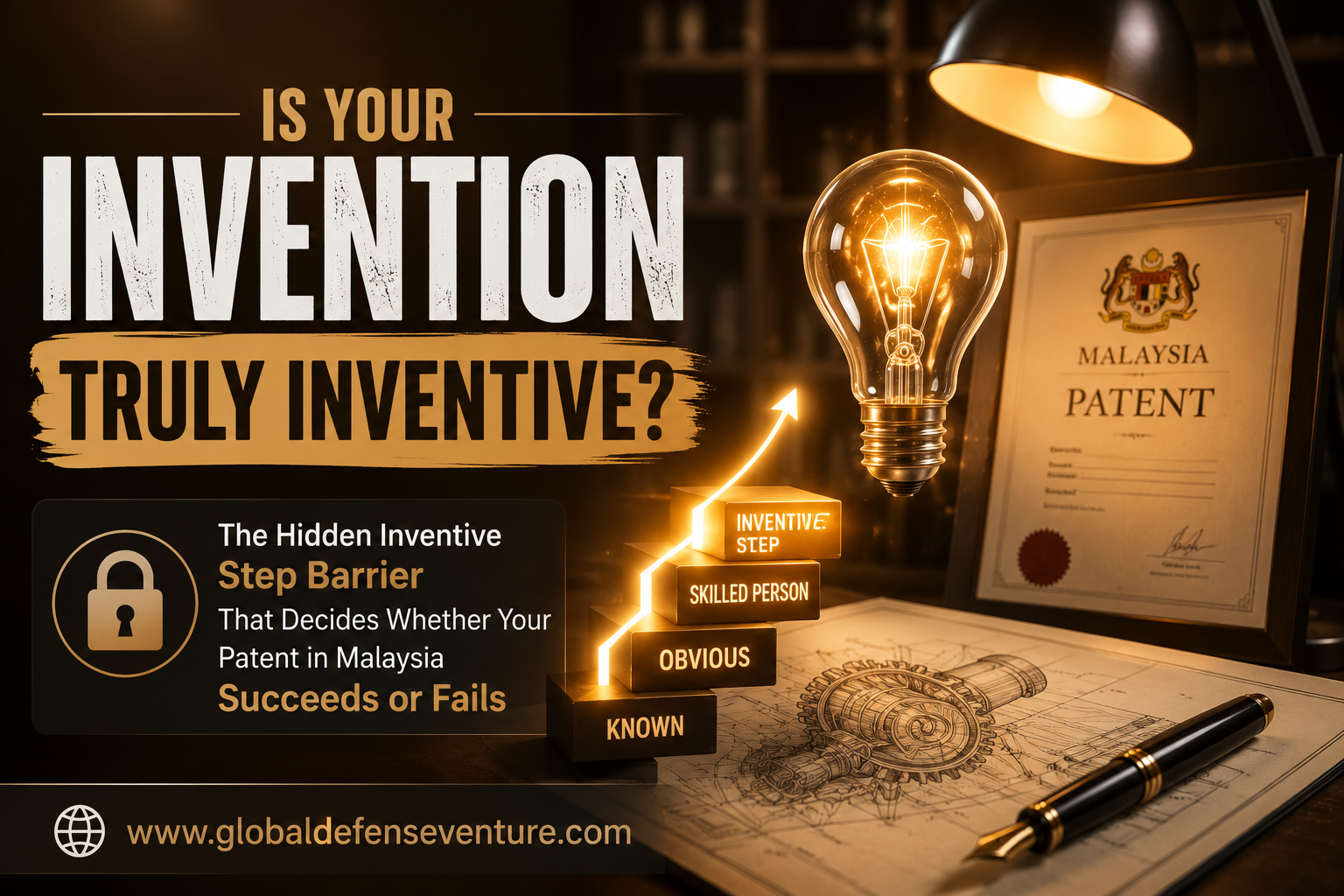
The “inventive step” means your invention must not be obvious to a person skilled in the relevant technical field, based on existing knowledge.
This is where many applicants are caught off guard. Something that feels groundbreaking to you may still be considered obvious in the eyes of examiners.
Why Most Patent Applications Fail Here
The majority of rejected patent applications in Malaysia fail not because the idea is copied, but because it is considered “obvious improvement.”
Common reasons include:
- Simple modifications of existing products
- Combining known technologies without unexpected results
- Incremental improvements without technical advancement
- Lack of demonstrated problem-solving innovation
The real challenge is not invention—it is proving inventive thinking.
How Examiners Evaluate Inventive Step
Patent examiners at Intellectual Property Corporation of Malaysia follow a structured approach:
They ask:
- What is the closest existing technology?
- What technical problem does your invention solve?
- Would a skilled professional naturally arrive at your solution?
- Does your invention produce an unexpected technical advantage?
If your answer feels predictable, your application risks rejection.
The Dangerous Assumption Inventors Make
Many inventors assume:
“If no one has done it before, it must be patentable.”
This is misleading.
Patent law does not reward effort alone. It rewards non-obvious innovation. A small tweak that feels significant in business terms may still be legally insignificant.
This misunderstanding is one of the most costly mistakes for startups and independent inventors.
Real-World Example of Inventive Step Failure
Imagine you improve a water bottle by adding a slightly better grip texture. Even if customers love it, the patent office may reject it because grip enhancements are widely known in product design.
However, if your grip design solves a previously unsolved slipping issue under extreme conditions using a unique material structure, that could qualify as inventive.
The difference is not size of change—it is technical unpredictability.
How to Strengthen Your Patent Application
If you want to survive the inventive step test, focus on these strategies:
1. Highlight the Technical Problem Clearly
Do not just describe your invention—explain the problem it solves in detail.
2. Show Why Existing Solutions Fail
Demonstrate gaps in prior technologies.
3. Emphasize Unexpected Results
If your invention produces surprising improvements, document them clearly.
4. Avoid Generic Claims
Broad or vague claims often weaken inventive step arguments.
5. Use Comparative Evidence
Show how your invention performs differently from closest prior art.
Why Timing Matters More Than You Think
Innovation protection is not just legal—it is strategic. Delaying your patent filing can expose your idea to public disclosure risks, which can destroy novelty entirely.
In competitive industries, waiting even a few months can determine whether your idea becomes an asset or public knowledge.
The Real Cost of Ignoring Inventive Step
Failing to meet the inventive step requirement does not just mean rejection. It can lead to:
- Loss of exclusive rights
- Competitive copying
- Weak investor confidence
- Reduced business valuation
In today’s fast-moving innovation economy, weak IP protection is a silent business killer.
Conclusion: Your Idea Is Not Enough—Your Thinking Must Be Stronger
An invention is not judged by how much effort you put into it, but by how non-obvious it is to the world.
If you are serious about protecting your innovation in Malaysia, you must start thinking like a patent examiner, not just an inventor.
Because in the end, the question is not:
“Did you create something new?”
It is:
“Would someone else have easily thought of it too?”